How long does startup fundraising take? Count the hours, too.
A practical pre-seed and seed fundraising workload: screening 500 funds, contacting 300, and counting the founder hours behind investor conversations and closing.

Say you’re a technical founder. You come up with an idea, build the first version over a week or two, and decide to raise a pre-seed round.
Then comes the advice: build relationships with VCs, get warm intros, prepare your data room, run a process.
Fair enough. But you’ve just built the thing. You haven’t spent the last six months getting to know 20-plus investors. And you might be nowhere near San Francisco.
So how much time are we actually talking about?
For pre-seed and seed, I’d look at two clocks: months until money reaches the company, and hours you personally spend getting there. The second one tends to disappear from the conversation.
“Three months” can hide a lot of work
DocSend’s 2024 research reported an average of 12 weeks for pre-seed fundraising, with most successful seed companies closing within 12 weeks. Useful context, but it doesn’t tell you how many founder hours went into those rounds—or how much network-building happened beforehand. DocSend’s research summary
“Closed in three months” sounds manageable. “Spent 700 hours raising” makes you think about what happens to product development, customers, and everything else on your plate.
Neither number predicts your outcome. A working MVP also doesn’t automatically make you investor-ready. You still need a credible story about the opportunity, what you’ve demonstrated, and what this cheque will help you achieve.
What does a fundraising workload look like?
For cold outreach, I’d build a target list of 300 relevant funds. Getting there might mean reviewing 500 or more: start with a quick screen, then research the shortlist properly.
Why so many? You’re building a funnel. Plenty won’t reply; some replies will be passes, and only a smaller group will move into serious discussions. Silence and rejection belong in the plan. Check your targeting and pitch as results come in, rather than assuming more volume will fix everything.
For illustration, assume 500 funds reviewed → 300 contacted → 30 replies → 20 initial calls → 6 deeper processes → 3 investors who fund. From a statistical point of view, this is a good scenario: it represents a 10% reply rate and a 1% funding rate among contacted funds. These are model assumptions, not market benchmarks or promised results.
Here’s our Round.Guru estimate of the founder workload, based on our experience and discussions with founders:
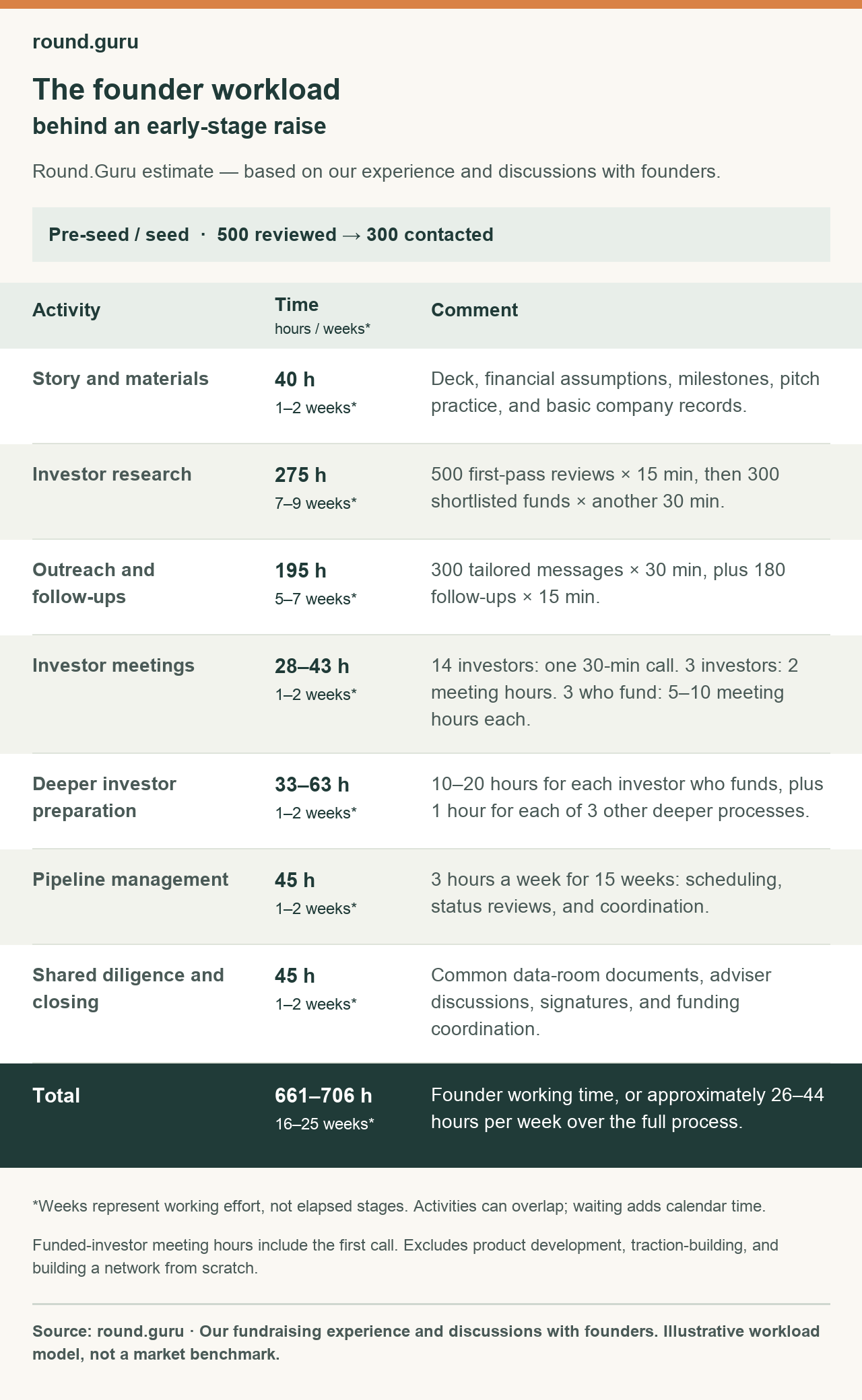
Round.Guru estimate, based on our experience and discussions with founders. Select the graphic to view it at full size.
The 5–10 meeting hours include the first call. Basic call preparation sits in research; deeper preparation covers investor-specific answers, analysis, and follow-up materials. Shared closing work is counted separately.
These assumptions exclude product development, traction-building, and developing a network from scratch. No-response funds still consume research and outreach time; waiting itself adds calendar time, not working hours.
That’s roughly 17 full-time working weeks, or 41–44 hours a week across 16 weeks. A short initial call is cheap. Getting the right investor from “interesting” to a funded commitment is where the work builds up.
Warm intros: count the work before the introduction
If someone who knows your work can introduce you to a relevant partner, great. Use that route.
But if you need to find a connector, develop the relationship, and earn their recommendation first, you have another project on your hands. Multiply that effort across your target list.
Imagine spending three months building access, then three months actively raising. Your journey took six months, even if you describe the round as a three-month raise. The networking hours also sit outside the workload example above.
Relationships have lasting value. Still, a founder ready to approach investors today needs a route they can use today. Building a network can happen alongside the raise.
And if you’re not in San Francisco?
In a startup hub, repeated encounters with founders, angels, and VCs can be easier to arrange. Outside that environment, you may need scheduled online conversations, travel, and more deliberate effort.
Geography also creates a separate question: can this fund actually invest in your company?
In our outreach preparation, we’ve seen promising portfolio matches run into geography, stage, or cheque-size constraints. “They invested in payments” is a starting point. It doesn’t establish that they back a pre-seed company incorporated in your jurisdiction.
Check that before spending weeks trying to get an intro.
Cold outreach moves the work somewhere else
Targeted cold outreach gives you a way to start without an established network. You spend more effort researching fit, identifying the right person, and making the investment case clear in a short message.
Michael Seibel’s YC guidance recommends concise investor emails explaining the company, team, and progress. A useful approach, with no promise that every relevant investor will reply. YC’s cold-email guidance
I’d use available warm intros and direct outreach together. And I’d run conversations in coordinated batches: waiting for one fund to finish before approaching the next makes every delay expensive. YC’s Aaron Harris also advocates a parallel process. YC’s fundraising discussion
Watch what moves through the funnel. A pleasant call is encouraging; a clear next step, diligence request, or partner discussion tells you more. Repeated objections may mean revisiting the target list or the investment story.
A commitment still needs to become cash
The structure affects timing. Where appropriate, SAFEs allow individual rolling closes, so you can receive the first cheque before completing the whole raise. A lead-led priced round may involve more coordination around terms, diligence, and closing conditions. Carta’s SAFE explanation
Varnum suggests allowing four to six weeks for a more complicated early-stage transaction involving several parties. That’s calendar time; your own workload depends on the questions and documents involved. Varnum’s closing checklist
Keep commitments and received funds separate in your cash planning.
Which hours should you do yourself?
You need to own the pitch, investor relationships, and decisions about terms. Research, contact checks, outreach preparation, scheduling, and pipeline administration are places where support can reduce your workload.
That’s the practical case for getting help: look at the hours someone can take off your plate, the quality of their work, and how they’re compensated. A success-based arrangement can align part of their compensation with a completed raise; the scope and terms still matter.
At Round.Guru, we help organize investor selection, personalized outreach, and follow-ups. If you’d like support running that process, talk to us about the workload and whether a success-based compensation arrangement could fit your raise.
Put it into practice with Round
Find the right investors, reach the right people, and manage every follow-up in one place.
Try Round.Guru